Defining Best-in-Class
Overview
Verizon wanted to deliver a best-in-class home internet experience but lacked a clear way to define and measure success. I identified this research gap and proposed a competitive benchmarking program to a product VP.
I led the program end to end, establishing measurable performance targets and identifying experience characteristics to inform product priorities.
Impact: Established measurable performance targets and evidence-based product priorities. The benchmarking framework was subsequently reused to evaluate Verizon's developing app, enabling the team to measure progress toward its best-in-class goal.
Approximately 4 months
From Ambition to Research Strategy
Defining what we needed to learn
Leadership's ambition to deliver a best-in-class experience raised two important questions: What performance should we aspire to, and what aspects of the experience would help us get there?
I developed a research strategy to answer both, establishing comparable measures of competitor performance while investigating the customer experiences behind those results.
Prioritizing stakeholder needs
Stakeholder discussions revealed broader research needs than originally anticipated. Hardware teams wanted to understand equipment setup, while app and design teams had questions about onboarding, network management, and customer instructions.
I worked with stakeholders to prioritize questions, assess feasibility, and negotiate a manageable scope. This required balancing different product priorities and development timelines while preserving the core benchmarking objectives.
Connecting performance to experience
I developed an end-to-end benchmarking approach spanning unboxing, router placement, onboarding, and everyday network management.
By combining quantitative performance measures with qualitative observations, we could understand not only how competing experiences performed, but what contributed to their success. This provided the foundation for measurable targets and evidence-based product priorities.
Measuring What Matters
I combined quantitative measures with qualitative observations to understand both how competing experiences performed and what contributed to their results.
Quantitative performance
Task success, completion time, perceived ease, confidence, and overall usability provided comparable measures of performance across competing experiences.
Qualitative understanding
Observing customer behaviors, expectations, and difficulties revealed the interactions, instructions, and design characteristics that helped or hindered successful task completion.
Recruiting for relevance, variation, and comparability
I recruited participants who were responsible for managing their household's home internet to ensure the tasks reflected relevant, real-world responsibilities.
I sought variation in both participant characteristics and home environments, including technical proficiency, home square footage, and number of floors, to reflect the diverse circumstances in which customers set up and manage home internet.
To minimize potential bias in comparative usability ratings, I excluded participants who reported using the products being evaluated. This recruitment decision was informed by prior research indicating that product familiarity can influence System Usability Scale (SUS) scores.
Balancing research rigor with feasibility
Given the complexity of the end-to-end experience, I designed two-hour sessions in which each participant evaluated two of three competing products. To achieve 12 evaluations per product while managing participant burden, I recruited 18 participants, plus one additional participant to pilot the research protocol.
To strengthen comparability, I counterbalanced product presentation order and standardized task instructions and data collection procedures. Participants independently read written task instructions to minimize variation in task presentation across sessions.
What Made Experiences Successful
The benchmark revealed experience characteristics that supported a central goal of the home internet app: empowering customers to independently set up and manage their home network and support their connected home. The findings helped establish evidence-based product priorities to support that goal.
Information architecture and terminology
Clear organization and familiar language helped customers locate and understand network management features.
Intuitive navigation and familiar terminology help customers independently manage an increasingly complex connected home.
Prioritize intuitive navigation, labels, and terminology.
Visual and multi-screen instructions
Visual guidance helped customers understand router placement and navigate setup activities.
Effective setup and equipment placement provide a foundation for reliable connectivity across the home and its connected devices.
Use clear visual instructions to support setup and placement.
Visible, accessible device controls
Customers valued being able to find and use essential network management functionality.
Accessible network controls help customers maintain connectivity and troubleshoot issues that can disrupt everyday activities throughout the home.
Make important network controls easy to discover and use.
Selected research findings have been generalized to protect proprietary information.
From Business Ambition to Measurable Progress
The research translated a broad best-in-class ambition into measurable performance targets and evidence-based product priorities.
I presented the findings and recommendations to product executives and cross-functional teams. The research influenced priorities for the developing home internet app, with particular emphasis on navigation, terminology, setup guidance, and network management functionality.
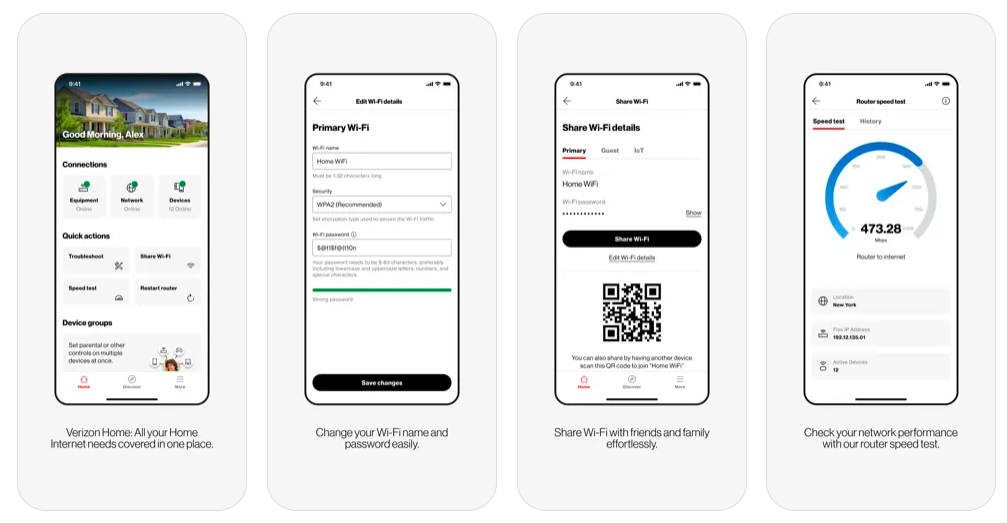
The benchmarking framework was subsequently reused to evaluate Verizon's developing app, enabling the team to assess progress toward its best-in-class goal.
Extending the value of research beyond a single study
By establishing a repeatable approach to evaluating the customer experience, the research provided a way to measure progress rather than simply identify opportunities for improvement.
It connected customer experience measurement to the broader business goal of enabling effective self-service and supporting the connected home.
What I'd Do Differently
I deliberately brought product executives and product teams together for the research readout. With limited opportunities to engage executives directly, I wanted everyone to hear the findings and recommendations together.
Looking back, I would follow that shared readout with smaller, team-specific sessions to discuss the findings, explore implications, and identify concrete next steps. This would create more opportunities for teams to translate the research into action.
Research has the greatest impact when we create opportunities for people to act on what they've learned.
Research Objectives
1. Evaluate and measure competitor user experiences
Are there issues setting up the hardware?
What are the task metrics for primary tasks on each app?
How do they compare across competitors?
What usability issues do participants encounter?
How does overall ease of use compare, and what factors contribute?
2. Understand user attitudes and perceptions
What are participants’ perceptions of each competitor’s experience?
What aspects contribute to their perceptions?
Do participants have preferences? What delights them? What are their pain points?
3. Identify user needs and current experiences (when applicable)
How do participants currently interact with their device and home app?
What are their needs and expectations?
What pain points do they experience in managing their network and connected devices?
Methodology
To answer these research questions, I designed a usability study where individuals participated in a one-on-one interview in our research lab. Each participant experienced two out of the three competitor products. Products were presented in counterbalanced order to account for possible order effects when making comparisons.
Participant Recruitment
Sample Size: 19 participants (ensuring at least 12 evaluations per product)
Criteria:
Mix of male and female
Primary home internet decision-makers
Age distribution between 25-60 years
Variety of internet providers and connected devices
No prior experience with the evaluated competitor products
Data Collection
Each participant was provided with a packet for each product that included the set of tasks, subjective questions, and SUS survey. They were asked to read each task aloud, complete the task, verbally state when they had completed each task and then respond to the subjective post task questions. When all tasks were completed on a product, participants completed the System Usability Scale survey (SUS). While participants were not discouraged from thinking aloud if they did so on their own. The tasks focused on:
Router setup and device placement instructions
App feature exploration and common tasks across all products
Metrics Collected:
Time on task
Task success rate
Perceived ease by task (SEQ)
Confidence rating by task
System Usability Scale (SUS) survey